

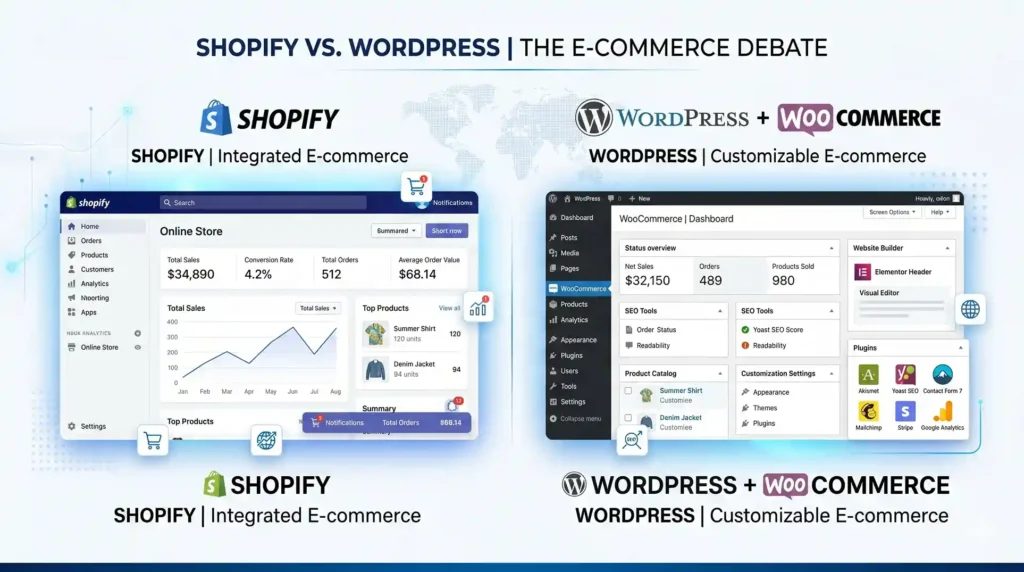
Choosing the right platform for your e-commerce website can make a huge difference in your business growth, website performance, SEO results, and long-term scalability. Whether you are a startup in India, a D2C brand in the USA, or a fast-growing business in the UAE, one question comes up again and again: Shopify vs WordPress for E-commerce Website – which platform is best for your e-commerce website?
The answer is not the same for every business.
Both Shopify and WordPress (with WooCommerce) are powerful platforms, but they are built for different types of users and business goals. Shopify is known for simplicity, speed, and all-in-one e-commerce management. WordPress offers unmatched flexibility, deep customization, and stronger content control for brands that want advanced SEO and tailored functionality.
In this detailed comparison, we’ll break down pricing, SEO, ease of use, design, performance, scalability, security, payment integrations, and international selling to help you choose the best platform for your business in India, USA, and UAE.
If you’re a small business owner, startup founder, or growing e-commerce brand, this guide will help you make the right decision in 2026.
Shopify vs WordPress: Quick Overview
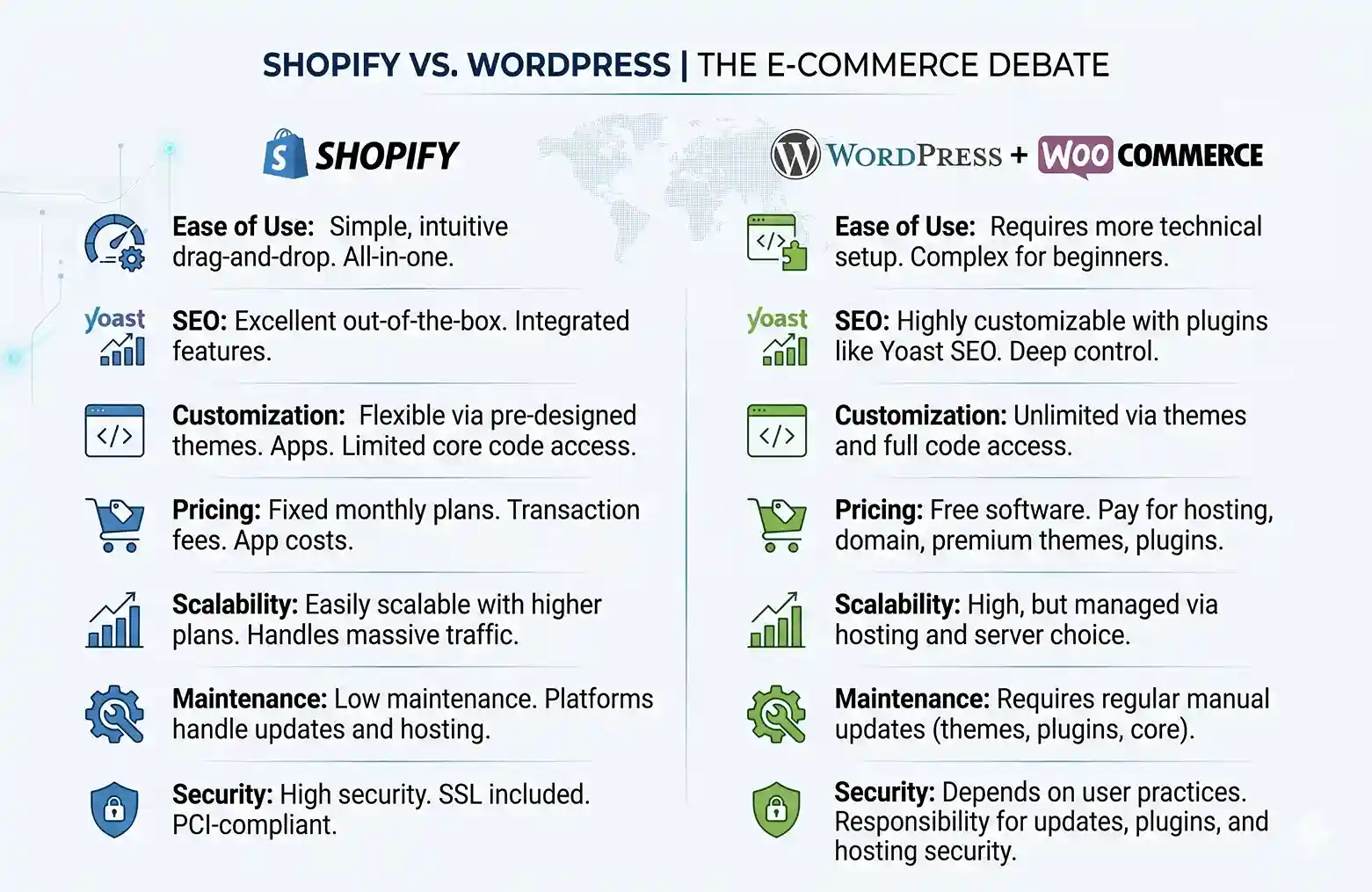
Before diving deep, here’s a simple overview:
- Choose Shopify if you want: a faster setup, easier management, built-in hosting, strong security, and minimal technical work.
- Choose WordPress if you want: complete control, custom design, advanced SEO flexibility, content marketing power, and scalable custom development.
In simple words:
- Shopify = easier and faster
- WordPress + WooCommerce = more flexible and customizable
What Is Shopify?
Shopify is a hosted e-commerce platform designed specifically for online stores. It allows businesses to create, manage, and scale an online store without worrying about hosting, security, updates, or server management.
Shopify is best for:
- Small businesses
- Fast-launch stores
- D2C brands
- Dropshipping stores
- Founders with limited technical knowledge
- Businesses that want easy maintenance
What Is WordPress for an E-commerce Website?
WordPress is a content management system (CMS), and when paired with WooCommerce, it becomes a highly powerful e-commerce solution. Unlike Shopify, WordPress is self-hosted, which means you have more freedom and control over your store.
WordPress + WooCommerce is best for:
- Businesses that want full customization
- SEO-driven brands
- Content-heavy websites
- Agencies building advanced e-commerce stores
- Businesses with unique feature requirements
- Long-term scalable custom projects
Shopify vs WordPress for E-commerce Website: Detailed Comparison
1. Ease of Use: Which Platform Is Easier to Manage?
Shopify
Shopify is much easier for beginners. It comes with:
- Built-in hosting
- Ready-made dashboard
- Easy product upload
- Built-in checkout system
- Easy app integrations
- Less technical setup
Even if you have no coding knowledge, you can launch a Shopify store quickly.
WordPress + WooCommerce
WordPress has a learning curve. You need to manage:
- Hosting
- Domain setup
- SSL
- Theme installation
- Plugin setup
- WooCommerce configuration
- Security and backups
Winner:
✅ Shopify wins for ease of use
If you want a store live fast with less technical stress, Shopify is better.
2. Pricing Comparison: Which Platform Is More Cost-Effective?
Pricing is one of the most important factors for businesses in India, USA, and UAE.
Shopify Pricing
Shopify usually includes:
- Monthly subscription
- Hosting included
- SSL included
- Basic e-commerce features included
- Paid apps (optional)
- Transaction fees (depending on payment setup)
WordPress + WooCommerce Pricing
WordPress can be more flexible, but cost depends on:
- Hosting plan
- Premium theme (optional)
- Paid plugins (optional)
- Developer support (if needed)
- Security / backup tools
- Performance optimization tools
Real-world insight:
- Small businesses with no tech team: Shopify often feels easier and predictable
- Brands needing custom features: WordPress may be more cost-effective long-term
Winner:
- Shopify for predictable pricing
- WordPress for long-term custom value
3. SEO: Which Is Better for Ranking on Google?
This is one of the biggest questions: Shopify vs WordPress SEO – which platform ranks better?
Shopify SEO
Shopify offers:
- Clean site structure
- Fast themes
- SSL security
- Mobile-friendly templates
- Product SEO basics
- Meta titles & descriptions
- Canonical tags (built-in)
But Shopify has some limitations:
- URL structure is less flexible
- Blog functionality is basic
- Advanced technical SEO customization is limited compared to WordPress
- Some schema/custom code control is more restricted
WordPress SEO
WordPress is widely considered stronger for advanced SEO because it gives you:
- Full URL control
- Better blog/content structure
- Advanced schema options
- Better internal linking control
- Strong plugin ecosystem (like Rank Math / Yoast)
- Custom SEO implementation flexibility
- Better content marketing potential
Best SEO Verdict:
If your goal is aggressive organic growth, content SEO, and long-term search visibility, then:
✅ WordPress + WooCommerce is generally better for SEO
Winner:
🏆 WordPress wins for SEO flexibility and content-led growth
4. Website Speed & Performance
Website speed affects:
- User experience
- Conversion rates
- Bounce rate
- SEO performance
Shopify
Shopify is hosted and optimized by default, so many stores perform well out of the box.
WordPress
WordPress can be extremely fast — but only if:
- Hosting is strong
- Theme is lightweight
- Plugins are optimized
- Images are compressed
- Caching/CDN is configured
Verdict:
- Shopify = easier to maintain performance
- WordPress = can be faster, but depends on setup quality
Winner:
✅ Shopify for easier performance management
✅ WordPress if professionally optimized
5. Design & Customization: Which Offers More Flexibility?
Shopify
Shopify themes are clean and conversion-focused, but customization can be limited unless you use Liquid or hire a developer.
WordPress + WooCommerce
WordPress gives you:
- Full design freedom
- Custom page builders
- Custom code
- Custom checkout flows
- Advanced UX/UI control
- Unlimited layout flexibility
Winner:
🏆 WordPress wins for design flexibility and custom development
If your brand needs unique features or a premium custom experience, WordPress is stronger.
6. E-commerce Features & Store Management
Shopify
Excellent built-in e-commerce experience:
- Product management
- Inventory
- Order tracking
- Discount codes
- Abandoned cart features
- App ecosystem
- POS integrations
- Multi-channel selling
WordPress + WooCommerce
WooCommerce is powerful but may require plugins for:
- Advanced shipping rules
- Advanced checkout features
- Subscription models
- Product filters
- CRM integrations
- Marketing automations
Winner:
🏆 Shopify wins for built-in e-commerce convenience
7. Payment Gateways for India, USA & UAE
If you want to target multiple countries, payment flexibility matters.
Shopify
Supports many international gateways, but availability varies by country and app ecosystem.
WordPress + WooCommerce
WooCommerce supports a massive number of payment gateway plugins and can be customized more deeply for:
- India payment options
- USA payment providers
- UAE regional gateways
- COD / local shipping / custom checkout rules
Winner:
✅ WordPress often wins for regional flexibility
✅ Shopify wins for easier setup
8. Scalability: Which Platform Is Better for Growing Brands?
Shopify
Great for:
- Fast-growing D2C brands
- Product-led stores
- Catalog growth
- International expansion
- Easier operations
WordPress
Best for:
- Businesses needing custom workflows
- Content + commerce hybrid brands
- Large SEO-led websites
- Complex feature integrations
- Multi-layer custom growth
Verdict:
- Shopify = scalable with simplicity
- WordPress = scalable with control
Winner:
✅ Tie – depends on business model
9. Security & Maintenance
Shopify
Shopify handles:
- Hosting
- Security patches
- SSL
- Server maintenance
- Core updates
WordPress
You need to manage:
- Hosting security
- Plugin updates
- Theme updates
- Malware protection
- Backups
- Firewall/CDN setup
Winner:
🏆 Shopify wins for security simplicity
10. Blogging & Content Marketing
If you want to rank through blogs, category pages, guides, comparisons, and informational content…
Shopify
Blogging exists, but it’s limited compared to WordPress.
WordPress
WordPress is the king of content marketing:
- Better content structure
- Better SEO plugins
- Better blog hierarchy
- Better editorial flexibility
- Better internal linking opportunities
Winner:
🏆 WordPress wins for blogging and content SEO
Shopify vs WordPress: Which Platform Is Best by Business Type?
Choose Shopify If You Are:
- A startup launching quickly
- A founder with limited technical knowledge
- A D2C or dropshipping brand
- A business wanting easy management
- Focused more on operations than custom development
- Wanting less maintenance
Choose WordPress + WooCommerce If You Are:
- A brand that wants advanced SEO
- A business relying on content marketing
- A company needing custom design or features
- A business wanting complete ownership/control
- A service + e-commerce hybrid brand
- Planning long-term organic growth
Best Platform by Region: India, USA, UAE
Best for India
- Shopify if you want fast launch & simple store management
- WordPress if you want SEO, custom features, local integrations, and cost flexibility
Best for USA
- Shopify works great for D2C and fast-scaling consumer brands
- WordPress is stronger for content-heavy and SEO-first brands
Best for UAE
- Shopify is strong for quick brand launches
- WordPress is excellent if you need custom payment, multilingual options, and region-specific UX
Final Verdict: Shopify vs WordPress – Which Is Better in 2026?
There is no one-size-fits-all answer.
Shopify is better if:
You want a simple, fast, secure, and easy-to-manage e-commerce store with minimal technical work.
WordPress is better if:
You want stronger SEO flexibility, full customization, better content marketing power, and long-term scalable control.
Our Expert Recommendation:
For small businesses and growing brands, the best choice depends on your growth strategy:
- Choose Shopify if speed, simplicity, and easy management matter most.
- Choose WordPress + WooCommerce if SEO, content marketing, and advanced customization matter most.
If your business goal is:
- Fast launch → Shopify
- Long-term organic SEO growth → WordPress
- Custom premium brand experience → WordPress
- Low-maintenance store operations → Shopify
Which Platform Do We Recommend for Most Businesses?
At DT Web Media, we generally recommend:
- Shopify for product-first brands that want quick launch and smoother store operations
- WordPress + WooCommerce for businesses that want stronger SEO, custom features, content-led growth, and long-term digital brand building
If you’re still confused, the right choice depends on:
- Your budget
- Your business model
- Your product catalog
- Your marketing strategy
- Your SEO goals
- Your long-term growth plan
Need Help Choosing the Right E-commerce Platform?
If you’re planning to launch or scale an online store in India, USA, or UAE, choosing the wrong platform can cost you time, money, rankings, and conversions.
At DT Web Media, we help businesses:
- Choose the right e-commerce platform
- Build SEO-friendly online stores
- Optimize Shopify & WordPress websites
- Improve speed, UX, and conversions
- Grow through organic search and performance marketing
👉 Need expert guidance?
Contact DT Web Media today for a free consultation and platform recommendation tailored to your business goals.